
- What’s the difference between summer, winter, and all-season tyres?
- All-Season Tyres Compared
- What are the drawbacks of all-season tyres?
- Who Are All-Season Tyres Suitable For?
- How much tread depth do all-season tyres need? The 4 mm rule
- What symbol must an all-season tyre have for winter?
- FAQ: Frequently Asked Questions About All-Season Tyres
Twice a year, a trip to the garage, booking an appointment, changing and storing your tyres: for many motorists, changing tyres is as much a part of the annual routine as fondue is in winter. It is no wonder that all-season tyres are becoming increasingly popular. One set of tyres for every type of weather sounds like the perfect deal.
But is it really? In this guide, you will learn how all-season tyres work, who they are suitable for and what you absolutely need to bear in mind in Switzerland.
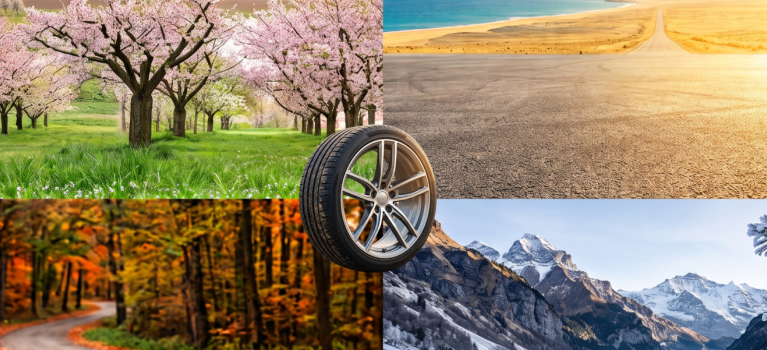
What’s the difference between summer, winter, and all-season tyres?
What makes summer tyres shine in warm weather?
Summer tyres are designed for temperatures above 7°C. Their rubber compound is harder, which provides shorter braking distances, precise handling and lower fuel consumption on warm tarmac. When temperatures fall below 7°C, the rubber becomes increasingly stiff and the tyre loses a significant amount of grip.
Why are winter tyres better in cold, snow, and ice?
Winter tyres use a softer rubber compound that remains flexible even in sub-zero temperatures. Deep tread patterns and fine sipes interlock with snow and ice, providing significantly shorter braking distances. In midsummer, however, they wear quickly and can feel less precise.
What are all-season tyres and how do they work?
All-season tyres (also known as all-weather or all-season tyres) are a technological compromise:
Rubber compound: harder than that of a winter tyre (less wear in summer), but softer than that of a summer tyre (better grip in cold conditions).
Tread: fine zigzag sipes in the centre for snow and slush, with larger tread blocks on the shoulders for stability when cornering and short braking distances on dry roads.
The biggest advantage: no tyre changes, no storage and therefore lower ongoing costs. In terms of purchase price, all-season tyres are roughly on a par with seasonal models.
All-Season Tyres Compared

What are the drawbacks of all-season tyres?
All-season tyres are a physical compromise. They need to perform on snow at minus 10°C just as well as they do on scorching tarmac at plus 35°C.
Here is what you should know:
Are All-Season Tyres Worse Than Winter Tyres in Snow?
Deep snow cover in the mountains: longer braking distances
The reason lies directly in the tread. Winter tyres are packed with deep sipes that effectively grip the snow. All-season tyres only have some of these features, because they also need to remain stable in summer. The result can be measured in metres: at −3°C on snow, a winter tyre travelling at 50 km/h comes to a stop after around 31 metres, while a mid-range all-season tyre needs about 37 metres. A summer tyre, by contrast, can take up to 62 metres – according to independent tests. The 6-metre difference compared with a specialist winter tyre may sound small, but in a critical situation it can make all the difference.
Do All-Season Tyres Have a Longer Stopping Distance in Hot Weather?
Scorching tarmac: longer braking distances, more wear
Here, it is the rubber compound that pays the price. To remain flexible in winter, an all-season tyre uses a softer compound than a pure summer tyre. In very hot conditions, this softer rubber is less resistant to deformation, meaning the tyre loses some precision and braking performance. On a dry road at 25°C, during an emergency stop from 100 km/h, a summer tyre stops after 36 metres, an all-season tyre after around 39 metres and a winter tyre, by comparison, only after around 42 metres. Noticeable, yes – but considerably less dramatic than the snow scenario.
Do All-Season Tyres Wear Out Faster?
365 days on the road: more wear
While drivers who switch between tyre sets can keep their tyres in storage for half the year, all-season tyres remain on the road year-round. As a result, their softer compound tends to wear somewhat faster than that of a dedicated summer tyre used in summer.
Who Are All-Season Tyres Suitable For?
All-season tyres are not suitable for everyone. For most average drivers, however, they provide perfectly adequate performance and offer a good compromise between everyday practicality and safety. They are particularly well suited to the following types of driver:
Low-mileage drivers (under 10,000 km/year): With two sets of tyres, the rubber often becomes hard with age before the tread has worn down. A single set of all-season tyres can therefore be used much more economically.
Urban commuters: On mostly cleared roads with reliable winter maintenance, their performance is more than sufficient.
People living in lowland areas: In regions with mild winters and no heavy snowfall, the compromise is a safe one.
Flexible drivers: Anyone who can leave their car at home during black ice or heavy snowfall and switch to public transport or work from home is not taking unnecessary risks.
You should stick with the traditional two-set approach if you regularly drive in the Alps or go skiing, drive in a sporty manner, cover long motorway distances every day or drive a heavy SUV. Particularly in heavy snow, on ice, at high speeds or under heavy vehicle loads, specialised summer and winter tyres offer more grip, better braking performance and more precise handling. Anyone who frequently drives in such conditions is therefore more likely to benefit from two sets of tyres designed specifically for the relevant season.
How much tread depth do all-season tyres need? The 4 mm rule
An all-season tyre must remain suitable for winter use at all times. By law, a minimum tread depth of 1.6 millimetres is required across Europe. However, the Swiss Federal Roads Office (FEDRO/ASTRA) and road safety experts strongly recommend replacing tyres intended for winter use at 4 millimetres.
Why? Below 4 millimetres, a tyre can no longer effectively displace snow and water. It then behaves much like a worn summer tyre. In winter conditions, this can be dangerous for you and other road users.
Our tip: Check your tread depth regularly, and at the latest before winter arrives.
What symbol must an all-season tyre have for winter?
A deep tread alone does not make a tyre a safe all-rounder. The symbols on the tyre sidewall are what matter:
3PMSF symbol (snowflake inside a mountain): Only tyres bearing the “Three-Peak Mountain Snowflake” symbol have passed standardised snow-braking tests and are legally recognised as full-fledged winter tyres. Modern all-season tyres carry this symbol.
The M+S trap: The “M+S” (Mud + Snow) marking is not legally protected and does not require the tyre to have passed any tests. A tyre bearing only the “M+S” marking does not meet the requirements for winter road conditions. It is legally treated like a summer tyre. In the event of an incident, fines and insurance claims for reimbursement may follow.
FAQ: Frequently Asked Questions About All-Season Tyres
Are all-season tyres legal in Switzerland?
Yes, provided they carry the 3PMSF symbol and have sufficient tread depth.
Are all-season tyres as good as winter tyres?
No. On roads with a continuous covering of snow, particularly in mountainous areas, genuine winter tyres have the advantage.
How long do all-season tyres last?
Because they are used all year round, they wear faster than seasonal tyres. You should replace them once the remaining tread depth reaches 4 millimetres.
What is the difference between M+S and 3PMSF?
M+S is not a protected marking and does not require any tests. The 3PMSF symbol requires tyres to have passed standardised braking tests on snow.
Are all-season tyres worthwhile for low-mileage drivers?
Yes. If you drive less than 10,000 km per year, a set of all-season tyres can often make the most sense. Above all, you save yourself the hassle of changing tyres seasonally.