Owning your own car means freedom. But many people pay a price for this freedom that they cannot accurately quantify. Did you know that most drivers in Switzerland underestimate their monthly costs by around half? Anyone who believes their car only costs 300 francs per month often actually pays over 600 or even 800 francs.
The year 2026 has made the situation even more challenging. While energy prices have fallen slightly, rising insurance premiums and new cantonal taxes are driving up the real costs. In this comprehensive guide, we show you step by step how to uncover your expenses and where you can save money with a car subscription.
Why Do We Underestimate the Ongoing Costs So Much?
The main reason for this massive miscalculation is psychological. Experts refer to this as “fragmented cost perception”.We primarily notice costs when we pay them directly – for example at the petrol station or at a charging point. However, according to TCS (2026), energy prices account for only around 11.5% of the total costs.
The remaining ongoing costs are often “invisible” or occur irregularly:
Insurance and taxes: These bills usually arrive only once a year.
Servicing and repairs: Servicing and repairs are often seen as one-off costs. In reality, they do not occur every month but can be very expensive. When these high individual costs are spread across the year, it becomes clear that they should be included in the monthly budget on average.
Depreciation: This is the largest cost component, yet it does not appear on any bank statement.
It only becomes noticeable when you sell the car and suddenly receive far less money than expected.
What Are the Average Monthly Car Costs in Switzerland?
When calculating the full cost, the average monthly car costs in Switzerland (2026) are around 700 to 1,000 francs for a mid-range car.
How Are Annual Car Costs Structured?
To obtain a clear picture, annual car costs must be divided into two main categories:
A. Fixed Costs (The Foundation)
These costs arise regardless of whether you drive 0 or 20,000 kilometres. They include:
Depreciation: Your car loses value every single day.
Insurance premiums: In 2026, comprehensive insurance premiums increased by up to 14% due to “claims inflation” (more expensive spare parts and sensors).
Motor vehicle taxes: Many cantons (for example St. Gallen) changed their tax systems in 2026. Even electric cars are now taxed more heavily.
B. Variable Costs (Usage)
These costs depend directly on how much you drive. They include:
Energy: Petrol, diesel, or electricity.
Tyres: The more you drive, the sooner you need new tyres.
Storage and seasonal changes also cost money.Maintenance: Oil changes, brakes, and general wear-and-tear parts.
Which Variable Costs Carry the Most Weight?
In addition to fuel, wear and tear is a major factor. Modern cars are packed with technology. Sensors for driver assistance systems mean that even small parking incidents or replacing a windscreen can now be extremely expensive.
Tyre costs are also often underestimated. A set of high-quality winter tyres for a heavy electric car can represent a significant share of running costs, including fitting and storage.
What Are the Real Car Costs per Kilometre?
One of the most honest metrics for car owners is the cost per kilometre. According to TCS calculations for 2026, the cost per kilometre is around 0.74 to 0.76 francs for a standard car.
This means that every time you drive 100 kilometres, you are actually spending about 75 francs. Many commuters only calculate the petrol cost (around 10–12 CHF per 100 km) and ignore the remaining 63 francs. This often creates significant gaps in household budgets.
Important: The cost per kilometre increases significantly if you drive very little. Fixed costs (insurance and taxes) remain the same but are spread across fewer kilometres.
The 3-Step Rule of Thumb: Your Detailed Calculation
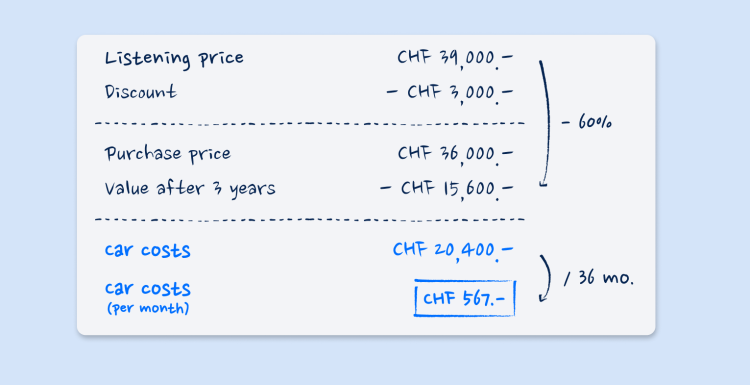
Let us look at a small electric car as an example: the Peugeot e-208 GT with a list price of around 39,000 francs. With a cash purchase and discount, the price is roughly 36,000 francs.
In the first three years, a new car typically loses around 50% of its value. For an electric car, depreciation of at least 60% is often assumed. As a result, the car in our example is worth around 15,600 francs after three years.
The difference between the discounted purchase price (36,000 francs) and the residual value (15,600 francs) is 20,400 francs. That is the amount the car actually costs during this period. Divided across 36 months, this results in monthly costs of 567 francs – purely car costs.
Step 1: Depreciation (The “Silent” Money Drain)
This is the amount your car loses in value every month.
Step 2: Additional Costs
All ongoing costs – including annual payments – are converted into monthly amounts - this is how you can see exactly what your monthly costs are:
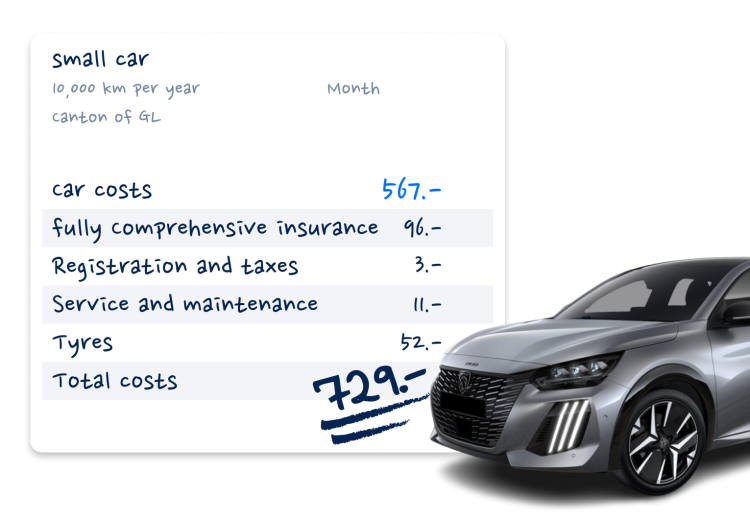
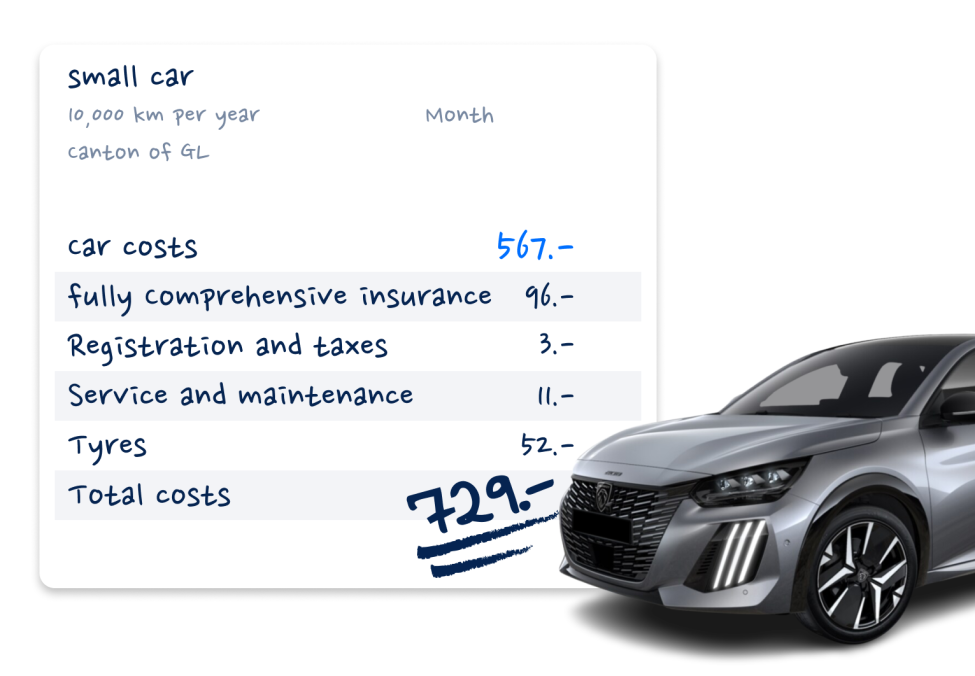
Car costs (567.–): This is the largest cost component. It usually includes depreciation (loss of value) as well as financing costs such as interest.
Fully comprehensive insurance (96.–): The monthly contribution for extensive insurance coverage that also protects against damage to your own car in the event of an accident you caused.
Registration and taxes (3.–): The proportional monthly costs for cantonal road tax (Glarus) and one-off registration fees.
Servicing and maintenance (11.–): A monthly reserve for regular inspections, oil changes, and minor repairs to ensure the operational safety of the car.
Tyres (52.–): The cost of purchasing tyres, seasonal changes (summer/winter), and storage, calculated per month.
Step 3: Compare the Final Result
You now have a realistic overview of the true costs of a car – using the example of the Peugeot e-208 GT.
How does this compare with a Carvolution car subscription?
Purchased Peugeot e-208 GT (monthly): CHF 729.–
Peugeot e-208 GT with a Carvolution car subscription
(no deposit, 36 months, 10,200 km per year, Canton of Glarus)
Monthly: CHF 609.–
The result is clear. With a car subscription, you not only save money but also avoid a great deal of hassle. In the subscription, all additional costs are already included – from insurance and servicing to tyres, taxes, and registration.
You pay a fixed monthly amount and do not need to worry about anything except refuelling or charging.
Conclusion: Transparency Protects Your Wallet
Anyone who understands their real costs makes better financial decisions. For many people in Switzerland, a car is the second-largest expense after housing. This simple calculation clearly shows that owning and maintaining a car in 2026 is more expensive than ever.
With a car subscription, you benefit from the purchasing power of a large fleet while keeping full control over your monthly costs.
You pay a fair fixed price and do not need to worry about anything – except driving and refuelling or charging.
If you still have questions about car costs or the car subscription, we would be happy to help. Simply arrange an appointment and we will clarify everything with you personally.
Sale
Benefit from attractive discounts on selected vehicles. Everything is included in the subscription, and a buyout is possible at the end!